
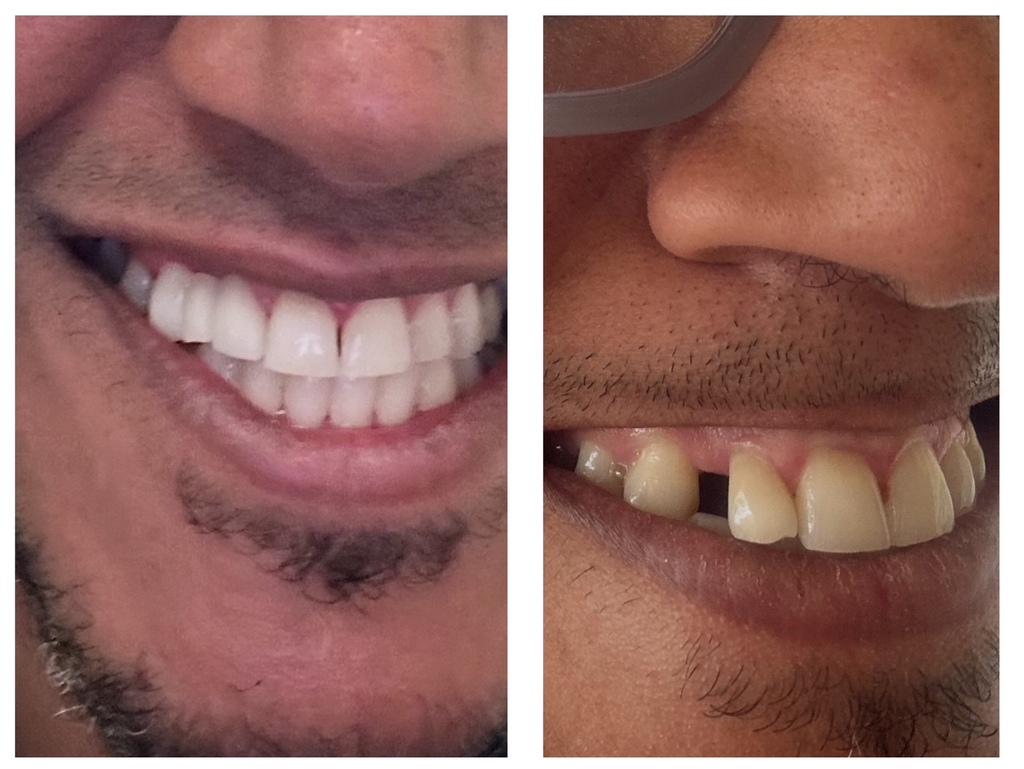
Dental implants are designed to provide a foundation for replacement teeth that look, feel and function like natural teeth. The person who has lost teeth regains the ability to eat virtually anything and can smile with confidence, knowing that teeth appear natural and that facial contours will be preserved. The implants are tiny titanium posts which are placed into the jaw bone where teeth are missing. The bone bonds with the titanium, creating a strong foundation for artificial teeth. In addition, dental implants can help preserve facial structure, preventing the bone deterioration which occurs when teeth are missing.
Dental implants are changing the way people live! With them, people are rediscovering the comfort and confidence to eat, speak, laugh and enjoy life.
If, like many others, you feel implant dentistry is the choice for you, we ask that you undergo a dental/radiographic examination and health history. During these consultation visits, your specific needs and considerations will be addressed. Your questions and concerns are important to us and our team will work with you very closely to help make your procedure a success.
Using the most recent advances in dental implant technology, Dr. Hassan is able to restore your implants. These implants do not require a second procedure to uncover them, but do require a minimum of six weeks of healing time before artificial teeth are placed. There are even situations where the implant can be placed at the same time as the tooth extraction – further minimizing your number of surgical procedures.
Dental implants are metal anchors, which act as tooth root substitutes. They are surgically placed into the jaw bone. Small posts are then attached to the implant, which protrude through the gums. These posts provide stable anchors for artificial replacement teeth.
For most patients, the placement of dental implants involves two surgical procedures. First, dental implants are placed within your jaw bone. For the first three to six months following surgery, the implants are beneath the surface of the gums, gradually bonding with the jaw bone. You should be able to wear temporary dentures and eat a soft diet during this time. At the same time, your restorative dentist designs the final bridgework or denture, which will ultimately improve both function and aesthetics.
After the dental implant has bonded to the jaw bone, the second phase begins. The surgeon will uncover the implants and attach a small healing collar. An impression must be taken. Then posts or attachments can be connected to the implants. The replacement teeth are then made over the posts or attachments. The entire procedure usually takes six to eight months. Most patients do not experience any disruption in their daily life.
Composite resin fillings are the most common alternative to dental amalgam. They are sometimes called “tooth-colored” or “white” fillings because of their color. Composite resin fillings are made of a type of plastic (an acrylic resin) reinforced with powdered glass filler. Composite resin is often placed in layers to build up the final restoration, then cured with an “ultra-violet light”. This light energy speeds up a chemical reaction of the components causing the soft material to harden and bond to the tooth. This material is considered safe. The color (shade) of composite resins can be customized to closely match surrounding teeth. This plastic and glass mixture contains no metal and can be shaped to resemble a real tooth. It is usually hard to tell that a tooth has even been filled!
Composite resin fillings have several advantages. The “white” color is preferred by many patients due to its ability to blend in with surrounding teeth. It is also possible to make a more conservative preparations when using composite material, thus enabling the dentist to preserve more natural tooth structure.
Since the resin used in tooth-colored restorations contains fluoride, it can help prevent decay. The resin wears like natural teeth and does not require placement at the gum line, another advantage that reinforces gum health.
In addition to being more aesthetically pleasing, composite fillings are completely safe and non-toxic. However, some believe that none of these advantages ring true for metal fillings. Some research suggests that amalgam fillings—made with mercury, silver, tin, copper and other metals—may lead to health problems.
The American Dental Association Council on Scientific Affairs has concluded that both amalgam and composite materials are considered safe and effective for tooth restoration.